
100 Years Ago Today · Evening Edition
Wednesday, November 10, 1926 · Gyeongseong · 10:10 PM KST (1:10 PM UTC)
10:10 – As the clock smiles, reflect on a century of history
1. Hook Opening
As you wind down your day, consider a strange kind of birthday party. Six days before this Wednesday, in a Seoul restaurant called Sikdowon, Koreans gathered to celebrate an alphabet. They called the occasion “Gagya Day.” Their country was a Japanese colony, and one of the few things they could still openly honor together was their own written language. Our search found no front page for November 10 itself, so tonight’s story follows the nearest confirmed record: November 4, 1926.

2. Korea Under Colonial Rule
The Korean Language Research Society, forerunner of today’s Hangul Society, held the gathering with the publisher Sinminsa. It marked the eighth 60-year cycle, 480 years, since the promulgation of Hunminjeongeum, the alphabet’s original name. “Gagya” comes from the opening of the old classroom chant, “ga-gya, geo-gyeo, go-gyo.” The Dong-A Ilbo carried the first report on page 5 of its November 4 issue, No. 2,240, according to an OhmyNews retrospective.
The same year was heavy. Emperor Sunjong died on April 25, and during his funeral procession on June 10 a student named Yi Seon-ho shouted for independence in front of Danseongsa theater, sparking the June 10th Movement. Song Hak-seon, who attacked a car in Seoul in the hope of striking Governor-General Saito, was sentenced to death in July and executed on May 19, 1927. We could not confirm any court record for November 10 itself.

3. East Asia in Turmoil
In China, Chiang Kai-shek’s Nationalist army was pushing north in the Northern Expedition. One source dates the capture of Nanchang to November 1926; we could not verify the exact day. The Nationalist government moved to Wuhan in December.

4. The World Stage
In the United States, a November 10 entry records Princeton severing athletic relations with Harvard. Three days later, at Hampton Roads, Virginia, Italy’s Mario de Bernardi won the Schneider Trophy seaplane race. These were the confirmed items; nothing more is claimed.

5. Colonial Parallels
Background note, not drawn from this edition’s searches: across the empires of the 1920s, language was a quiet front line. Ireland’s Gaelic revival and India’s vernacular press both treated a mother tongue as proof that a people still existed. Gagya Day belongs to that family of acts.
6. Person of the Day
Park Doo-seong, pen name Songam, announced Hunmaengjeongeum on that same November 4. It was a Korean braille system that let blind Koreans read and write their own language. Its 100th anniversary falls this year, 2026. To give a person letters is to give them a place at the table.
7. Understanding Daily Life
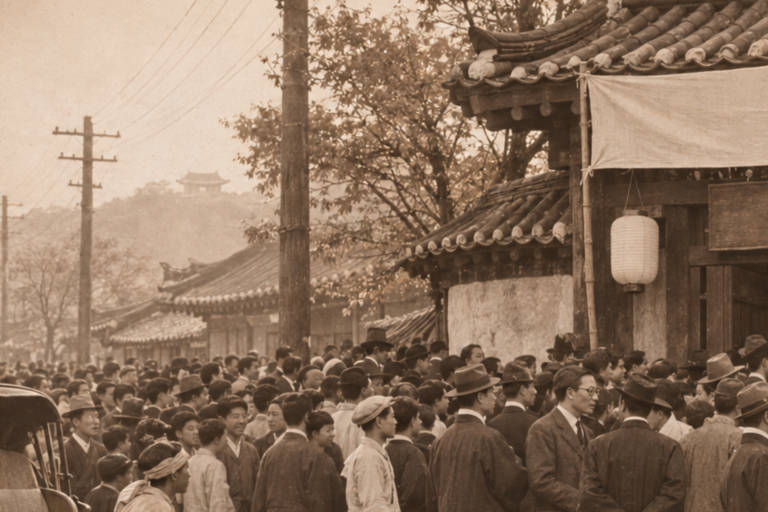
We found no confirmed weather, prices, or street scenes for November 10, so none are invented here. What we can say is that in Seoul in 1926, public celebrations of Korean identity were small, organized by private societies and held in restaurants, and the press was watched. A gathering over dinner was a modest act with a large meaning.

8. Century Mirror
Today Hangul Day falls on October 9. The name changed in 1928, and the date was fixed only after the Hunminjeongeum Haerye manuscript turned up in 1940. A century on, a language that needed a restaurant dinner to be celebrated now carries K-pop lyrics and K-drama subtitles around the world. In 1926 people created the holiday themselves. Now it sits on the national calendar.

9. Tomorrow’s Preview
Tomorrow, Thursday, November 11, is our day for labor and economy. Until then, good night.

⇓ PNG 다운로드
스마트폰의 WIA Code 스캐너로 이 화면을 약 152초 비추면 기사 전체가 폰에 저장됩니다 — 인터넷 없이 읽을 수 있습니다. WIA Code 스캐너 열기
This code contains the original Korean article.




Leave a Reply
Please log in to comment.