
100 Years Ago Today
Friday, November 5, 1926 · Evening Edition · 10:10 PM KST (1:10 PM UTC)
10:10 – As the clock smiles, reflect on a century of history
1. Hook Opening
Good evening. Imagine a country where the alphabet you write your grandmother’s letters in has no national holiday, no official school status, and no government to protect it. Now imagine a few hundred people crowding into a Seoul restaurant to celebrate that alphabet anyway. That is where we begin: November 5, 1926, the morning after Korea’s first-ever “Gagyanal,” the day that would later become Hangul Day. We could not confirm the weather in Seoul that day, so we will not invent it. What we can confirm is a quiet act of cultural defiance, and it is worth a few minutes of your evening.

2. Korea Under Colonial Rule
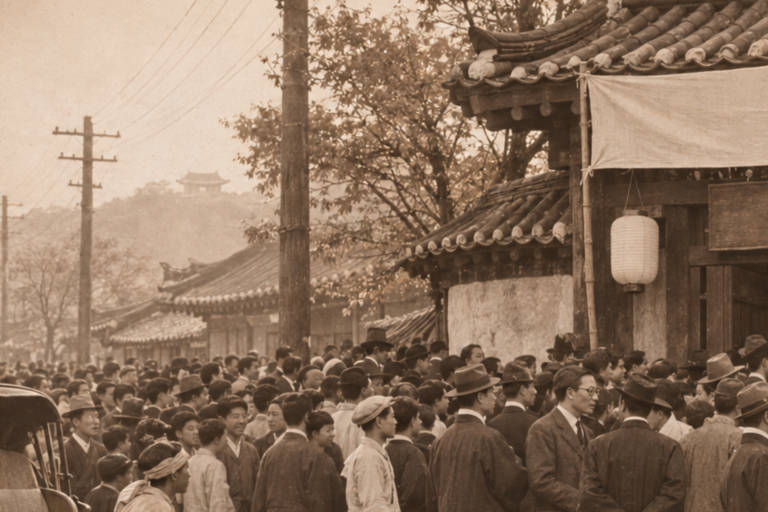
Korea had been under Japanese rule for sixteen years. On November 4, page five of the Dong-A Ilbo (issue No. 2,240) ran a headline that read, roughly, “A New Light for Hangul: Today Is Gagyanal.” Its subtitle urged readers to “announce our writing to the world for the first time” and to “commemorate this day forever.”
The Korean Language Research Society and the publisher Sinminsa organized the event to mark the 480th anniversary of Hunminjeongeum, the 1446 proclamation of the Korean alphabet. Four hundred and eighty years is exactly eight cycles of sixty, which Koreans call eight “hoegap.” The gathering was held at a restaurant called Sikdowon at 6 p.m. on the 29th day of the ninth lunar month, which fell on November 4. A lecture followed at the Central YMCA hall at 7 p.m. on the 6th, and organizers talked of literacy classes for the countryside. The article does not name the attendees, and we have not seen the November 5 issue itself.

3. East Asia in Turmoil
Our searches did not turn up dated reports from China or Japan for November 5, so we will stay cautious. In general terms, 1926 was the year the Chinese Nationalist army launched its Northern Expedition from Guangzhou toward the Yangtze, and Korean exiles in Shanghai and Manchuria watched closely. That is background, not a record of this particular day.
Closer to home, a third private Korean-language newspaper, the Jungoe Ilbo, appeared in November 1926. It joined the Dong-A Ilbo and Chosun Ilbo, which made for a crowded press market in a country where every page passed under colonial censors. We could not confirm its exact launch date.

4. The World Stage
Elsewhere on November 5, talks reopened in Britain between the government and the Miners’ Federation, as the coal lockout entered its seventh month. Lithuania’s parliament voted to ratify its non-aggression pact with the Soviet Union, signed on September 28. In the United States, the Hall-Mills murder trial dominated the front pages, and Congress was weighing tax cuts of a few hundred million dollars. On November 4, Prince Leopold of Belgium married Princess Astrid of Sweden in Stockholm.
Looking one day ahead, Italy’s cabinet would enact a sweeping police law on November 6 that allowed political and cultural groups to be dissolved. The mood across Europe was mixed: ceremonies in one capital, shrinking liberties in another.

5. Colonial Parallels
Language has often been the front line of colonial life. In Ireland, the new Free State, established in 1922, made Irish a school subject as part of rebuilding national identity. Under Japanese rule, Korean children were taught in a system where Japanese held official status, and a Korean-language holiday was a statement in itself. The details differ from place to place, and we make no claim of a direct link between these events. The shared pattern is that a community under foreign rule turns to its own writing system as a way to hold itself together.
6. Person of the Day
Park Doo-seong, known by his pen name Songam, is credited with unveiling Hunmaeng Jeongeum, a Korean braille system for blind readers, on that same November 4. Later accounts describe it as an effort to let people who cannot see print read and write Korean. We could only find this in later sources, so we do not know how the day’s newspapers treated it. Still, it is a reminder that “protecting a language” meant making it reachable for everyone.
7. Understanding Daily Life
Fridays in our series usually turn to women, family, and religion. For this date, we found no confirmed report on those subjects, and we will not fabricate prices or street scenes. What the sources do show is that literacy was uneven: organizers specifically planned classes for rural areas, which suggests that reading Hangul was not yet a given for every household. Hangul was easy to learn, but access to teachers and schools was a separate matter.
8. Century Mirror
Gagyanal took its name from “ga, gya, geo, gyeo,” the beginning of the traditional order in which learners recited the letters. In 1928 it was renamed Hangul Day. The date later moved to October 9 after the discovery of the Hunminjeongeum Haerye manuscript in 1940, which supported a September 1446 completion. Today, Korean is read by fans of K-pop and K-drama worldwide, and many learn the alphabet in an afternoon. The 1926 crowd, gathering in a restaurant under colonial watch, would be astonished.
| Item | 1926 | 2026 |
|---|---|---|
| Name | Gagyanal | Hangul Day |
| Date | 29th of 9th lunar month | October 9 |


9. Tomorrow’s Preview
Tomorrow, Saturday, November 6, the Gagyanal lecture is scheduled at the Central YMCA hall. Rest well. We will be back at 10:10.
Sources: Dong-A Ilbo, Nov. 4, 1926, p. 5 (as discussed by OhmyNews); National Institute of Korean Language materials; Wikipedia, “November 1926.” The November 5 newspapers themselves were not reviewed.

⇓ PNG 다운로드
스마트폰의 WIA Code 스캐너로 이 화면을 약 153초 비추면 기사 전체가 폰에 저장됩니다 — 인터넷 없이 읽을 수 있습니다. WIA Code 스캐너 열기
This code contains the original Korean article.






답글 남기기
댓글을 달기 위해서는 로그인해야합니다.