
.hyat-en-wrap{font-family:’Georgia’,serif;background:linear-gradient(180deg,#1a1a2e 0%,#16213e 50%,#0f3460 100%);padding:16px 0;max-width:760px;margin:0 auto}
.hyat-en-head{background:linear-gradient(135deg,#0f3460 0%,#16213e 50%,#1a1a2e 100%);color:#fffef7;text-align:center;padding:24px 16px;border-bottom:3px solid #ffd700;font-family:’Playfair Display’,serif}
.hyat-en-head .dt{font-family:’Courier Prime’,monospace;color:#ffd700}
.hyat-en-sec{background:#fffef7;color:#2c3e50;margin:14px 12px;padding:8px 18px;border-left:4px solid #0f3460;line-height:1.75}
.hyat-en-sec h2{font-family:’Playfair Display’,serif;color:#0f3460}
.hyat-en-sec .note{color:#555;font-size:13px}
.hyat-en-sec table{width:100%;border-collapse:collapse;font-size:14px}
.hyat-en-sec th,.hyat-en-sec td{border:1px solid #0f3460;padding:6px;text-align:left}
.hyat-en-sec th{color:#0f3460}
100 Years Ago Today · Evening Edition
1. A Sunday Between Two Dates
As you wind down your day, picture Seoul on a Sunday a century ago, with winter close at hand. We could not find a source describing the weather that day, so we will not invent one. What we can verify is what surrounded it. Three days earlier, on November 4, a group of Korean scholars held the first “Gagyanal,” the ancestor of today’s Hangul Day. Eight days later, a new Korean-language daily would appear. November 7 sits quietly between the two.
Note: we did not locate a source that reports on this exact date in a Korean newspaper. Everything below is anchored to dated, checkable facts.

2. Korea Under Colonial Rule
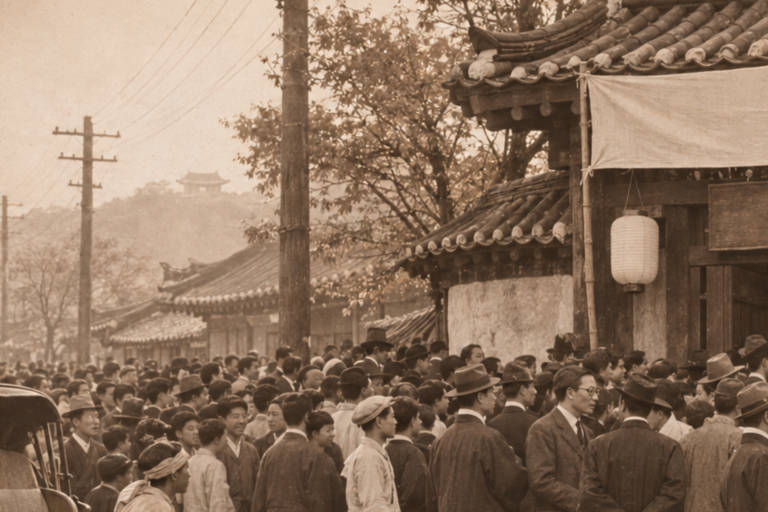
Korea had lived under Japanese colonial rule since 1910, and censorship shaped what could be printed. On November 4, around a hundred intellectuals gathered at the Sikdowon restaurant. The Korean Language Research Society and the magazine publisher Sinminsa were marking the 480th anniversary of the promulgation of Hunminjeongeum, the original name of the Korean alphabet. They chose the 29th day of the ninth lunar month, which fell on November 4. They called it “Gagyanal,” after the first syllables of the old alphabet chant. Donga Ilbo reported it briefly on page 5. In 1928 the name changed to “Hangul Day.”
The year had been heavy. Emperor Sunjong, Korea’s last monarch, died on April 26, and the June 10 independence demonstrations followed his funeral. One account says about 1,000 people were detained but only 11 were tried.

3. East Asia in Turmoil
In China, Chiang Kai-shek’s Northern Expedition had been under way since July 9, aiming to break the power of regional warlords. In Japan, Emperor Taisho was ailing, and his son Hirohito had served as regent since 1921. Taisho would die on December 25, ushering in the Showa era. For Koreans, each shift in Tokyo or China was watched closely, since it could change the pressure on daily life at home.

4. The World Stage
On this very day, Greece held a parliamentary election, its first under simple proportional representation. The Liberal Union won 108 of 286 seats, the most of any party but short of a majority, so coalition talks followed. In London, the Imperial Conference had been meeting since October 19. On November 15 it would adopt the Balfour Declaration, which described Britain and its dominions as equal in status. In Moscow, Leon Trotsky had been removed from the Politburo that October. It was the ninth anniversary of the Bolshevik seizure of power, which Soviet authorities marked on this date.
5. Colonial Parallels
Consider the contrast. The Irish Free State, born from an independence struggle, sat in London as one of the dominions declared equal to Britain. In India, a nationalist movement pressed for self-rule under British administration. Korea had no seat at any such table. Its people could not even publish freely in their own language without careful navigation of the censors. Yet on November 4, in a restaurant, they quietly claimed that language as a national treasure.

6. Person of the Day
Na Un-gyu, a young filmmaker, made his debut as a director with the silent film “Arirang,” which opened at the Dansungsa theater in Seoul on October 1, 1926. Reports say it was a major success in theaters across the country. Its theme song is recorded as the first film theme song in Korea, and also its first banned song. Beyond these facts, we found no details of his day on November 7, so we leave it there.
7. Understanding Daily Life
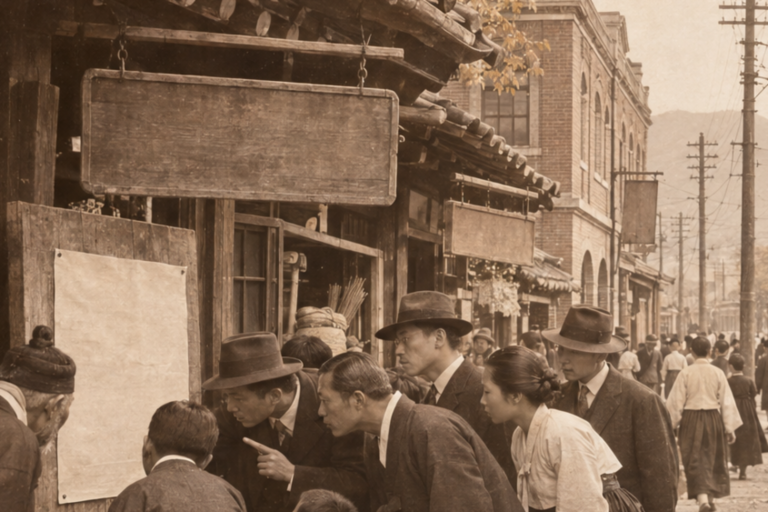
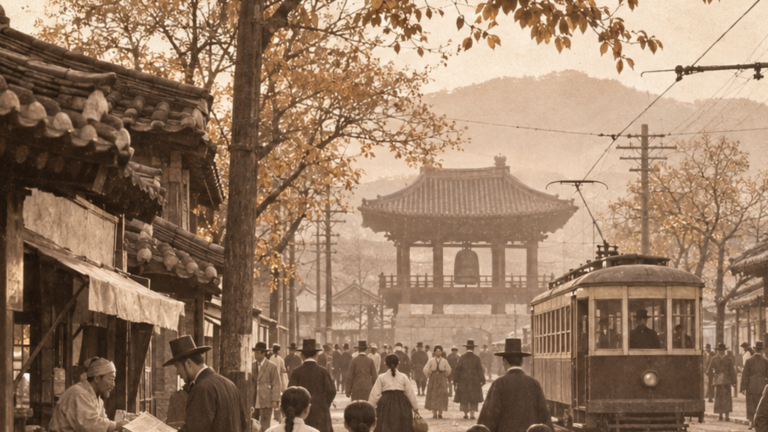
We found no source for prices, weather or street scenes on this Sunday, and we will not guess. What we can say is that the city had theaters showing films like “Arirang,” newspapers competing for readers, and a growing public conversation about the Korean language. On September 18, a newspaperman named Yi Sang-hyeop acquired the publishing rights of the defunct Sidae Ilbo. On November 15 he would launch it as Joongoe Ilbo, giving Seoul a third privately run Korean daily alongside Donga Ilbo and Chosun Ilbo.

8. Century Mirror
| Item | 1926 | 2026 |
|---|---|---|
| Name | Gagyanal (renamed Hangul Day, 1928) | Hangul Day |
| How marked | About 100 people at a restaurant | Public holiday every October 9 |
| Meaning | 480th anniversary of the alphabet | Reported as the 100th anniversary of Gagyanal |
| Korean-language dailies | Two, with a third due November 15 | — |
Hangul Day was dropped as a public holiday for a time and restored in 2013. Today, a language once celebrated by a hundred scholars is on playlists, screens and K-dramas worldwide.

9. Tomorrow’s Preview
Tomorrow is Monday, November 8, 1926. As the night settles in, rest well, and join us again at 10:10.
Sources: Donga Ilbo, Nov 4, 1926, p. 5 (secondary citation); Encyclopedia of Korean Culture (Joongoe Ilbo); general chronologies for the Greek election and Imperial Conference.




답글 남기기
댓글을 달기 위해서는 로그인해야합니다.