

At dawn on a mountain above the East Sea, the first light of the sun slips into a dark stone chamber and touches the forehead of a seated Buddha. People built it that way more than twelve centuries ago.
Seokguram, on Mt. Toham near Gyeongju, is among the most admired Buddhist sculptures in Asia. It is also a case study in how heritage can be both made and unmade: a masterpiece of 8th-century engineering that, in the 20th century, became a textbook example of the risks of well-meant restoration.
When Europe was building Carolingian churches of timber and rubble, Silla’s craftsmen assembled a stone dome with no mortar. How did they do it, and why did a structure that survived most of 1,200 years begin to fail only in the last century?
🌍 Western Historical Parallel
Construction began in 751, the same year Pepin the Short was elevated to king of the Franks, founding the Carolingian line. Roughly two centuries earlier, Justinian’s builders had raised the great dome of Hagia Sophia (537). Seokguram is far smaller, but like Hagia Sophia it is a building in which geometry, light and faith were designed as a single experience.
◆ The Ancient Landscape
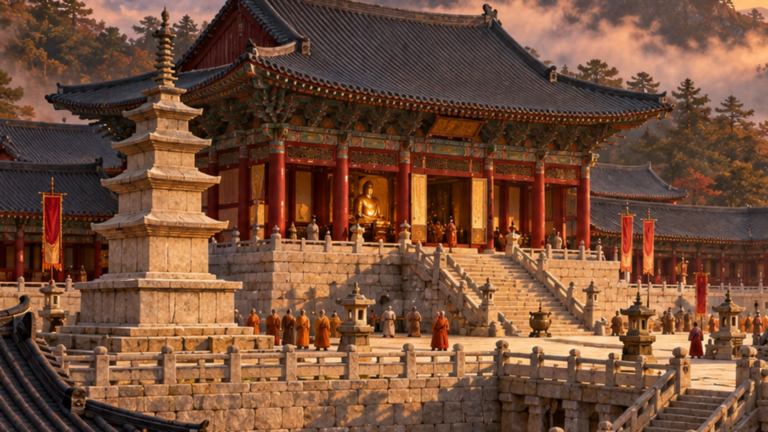
By the mid-8th century, Unified Silla had enjoyed nearly a century of peace after absorbing Baekje (660) and Goguryeo (668). King Gyeongdeok (r. 742–765) reorganized offices and place names on Chinese models, and his capital, today’s Gyeongju, was a city of aristocrats, monasteries and markets. Buddhism provided the ideological backbone of royal authority.
According to the Samguk Yusa, the minister Kim Daeseong began building Bulguksa for his parents in this life and a stone temple, Seokbulsa (today’s Seokguram), for his parents of a previous life, in 751. After his death the state completed the work, traditionally dated to about 774. Some scholars, citing records found in Bulguksa’s pagoda, think planning may have started as early as around 742.
“The minister Daeseong began building Bulguksa in the tenth year of Tianbao (751) and founded Seokbulsa for his parents of a former life … when Daeseong died in the ninth year of Dali (774), the state completed it.” (paraphrased summary)
◆ Same Era, Different Worlds
🏛️ China
Tang China under Xuanzong. Tang forces lost to the Abbasids at Talas in 751, and the An Lushan Rebellion (755) ended the dynasty’s golden age.
🗿 Byzantine Empire
The Iconoclast era. While Silla enshrined a monumental Buddha, Constantinople fought over whether sacred images were permissible at all.
⚔️ Western Europe
The Franks under Pepin and soon Charlemagne (emperor in 800) were consolidating a new dynasty; monumental stone building was rare.
🕌 Islamic World
The Abbasid Caliphate took power in 750 and soon built Baghdad as a center of learning.
Seokguram: Cross-Section Concept
Spring water beneath the floor (natural dehumidifier)
Sunrise over the East Sea
Round main chamber · domed ceiling
Main Buddha
Antechamber
[Image: Conceptual cross-section — round chamber, stone dome, Buddha facing the sunrise (illustrative, not a measured drawing)]
⚔️ Scene from That Day
“Before dawn on Mt. Toham the chamber is black. A monk stands before the Buddha the masons have just finished. Over the sea the sky reddens, and a thin blade of light enters the passage and finds the Buddha’s brow.”
“The stone seems to breathe. (This scene is a reconstruction from the building’s known orientation; no eyewitness account survives.)”
◆ Uncovering Historical Truth
Seokguram is not a natural cave. It is an artificial grotto of cut granite, built up and then covered with earth. A rectangular antechamber and corridor lead into a circular main chamber with the Buddha at its center under a domed ceiling. Bodhisattvas, disciples and guardian kings line the walls. The shift from square to circle is commonly read as a movement from earth to heaven, a geometry familiar from Roman and Byzantine domed buildings, though achieved here with stacked stones rather than concrete or brick.
The engineering is subtle. The dome is made of interlocking stones, and spring water ran beneath the floor, keeping the floor cooler than the walls. Moisture would condense on the cold floor rather than on the sculptures, an elegant passive dehumidifier, as many researchers now explain it. The Buddha faces the East Sea and the sunrise. Compare this with Roman builders, who relied on hydraulic concrete to span the Pantheon’s dome. Silla’s craftsmen solved a similar problem with carved stone and water management.
The trouble came in modern times. The Japanese Government-General of Korea dismantled and repaired the grotto in 1913–1915 and again later, using concrete. Ventilation and drainage were altered, and humidity and condensation worsened. Repairs in the 1960s treated groundwater as the culprit and did not end the condensation. Today a glass wall and climate-control equipment protect the interior. Seokguram became a National Treasure in 1962 and, together with Bulguksa, a UNESCO World Heritage Site in 1995.
Period
Mid-8th century CE (751 to c. 774)
Key Figure
Kim Daeseong; King Gyeongdeok
Structure
Artificial granite grotto with a stone dome
Recognition
UNESCO World Heritage, 1995
🔍 International Academic Perspectives
Korean/Asian Scholars
Most attribute the condensation problem largely to modern repairs that changed Silla’s ventilation and drainage. The main figure is widely read as Shakyamuni at the moment of enlightenment.
Alternative Views
Some argue the Buddha is Amitabha, and others note the original design also needed ongoing care. Outside Korea, UNESCO’s inscription stresses the site’s outstanding artistic and architectural value.
📖 Key Terms Explained
- Silla (신라)
- Korean kingdom traditionally founded in 57 BCE; it unified most of the peninsula in 668 CE and lasted until 935.
- Samguk Yusa (삼국유사)
- 13th-century collection of legends and history by the monk Iryeon, a key source on Silla Buddhism.
- Grotto
- A cave-like sanctuary. Unlike India’s rock-cut caves, Seokguram is built from stone blocks and buried.
◆ Lessons for Today’s World
Seokguram shows a fusion of science and art that today’s fields keep trying to rebuild: architecture, optics, hydrology and aesthetics resolved in one design. It is a reminder that “design” once meant integrating knowledge, not splitting it.
Its restoration history is also a warning that echoes in heritage debates from Notre-Dame to Palmyra: intervention without understanding the original system can do harm. Modern conservation increasingly favors monitoring, reversible measures and thorough documentation.
| Aspect | Silla Era | Modern Parallel |
|---|---|---|
| Statecraft | Buddhism as royal ideology and a prayer for the state | Heritage as national brand and soft power |
| Technology | Passive systems: spring water, airflow | Climate control and sensor monitoring |
| Culture | A serene smile carved in granite | Conservation ethics and shared World Heritage duty |
1,200 Years of Seokguram
751
Construction begins
c. 774
Completed by state
1913–15
Colonial dismantling
1960s
Repair campaign
1995
UNESCO listing
Science + Art + Stewardship
Carrying the smile into the next millennium
[Image: From an ancient grotto to a modern conservation challenge]
📚 Diving Deeper
- Visit Seokguram and Bulguksa, inscribed together on the UNESCO World Heritage List in 1995 (criteria i and iv).
- For comparison with a near-contemporary royal treasure, see the Sutton Hoo ship burial in England (early 7th century), and Todaiji’s Great Buddha in Nara, dedicated in 752.
- Further reading: the Samguk Yusa (Ha Tae-hung and Grafton Mintz translation) and the Cambridge History of Korea volumes on early Korea.
The Voice of Living History
Seokguram is not a finished relic but a heritage that still needs tending. The wisdom of its makers and the responsibility of its keepers must travel together if the smile is to last.
“A thousand-year smile rests not on the stone, but on our will to protect it.”
Previous Episode
Episode 21: King Gyeongdeok and Bulguksa — The Flower of Buddhist Art
Next Episode
Episode 23: Wonhyo and Uisang — Two Giants of Silla Buddhism
The Korean Today “History Lives On” Series
The Silla Chronicle (35 Episodes)
Bridging Ancient East Asia and the Modern World
© 2025 The Korean Today. All rights reserved.
This content is based on historical facts and presents balanced academic perspectives
for international readers.

⇓ PNG 다운로드
스마트폰의 WIA Code 스캐너로 이 화면을 약 33초 비추면 기사 전체가 폰에 저장됩니다 — 인터넷 없이 읽을 수 있습니다. WIA Code 스캐너 열기
This code contains the original Korean article.



답글 남기기
댓글을 달기 위해서는 로그인해야합니다.