
100 Years Ago Today · Evening Edition
Monday, November 8, 1926 · 10:10 PM KST (1:10 PM UTC)
10:10 – As the clock smiles, reflect on a century of history
Hook: Four Days After a Language Got Its Holiday
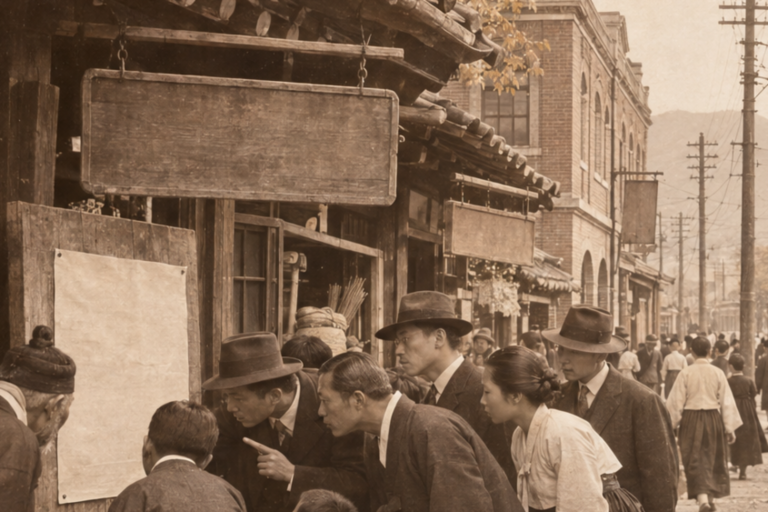
Good evening. It is Monday, November 8, 1926, in Gyeongseong, the colonial name for Seoul. We could not find a surviving Korean newspaper page dated exactly this day, so tonight we stay with what can be confirmed around it. Four days earlier, on November 4, the Joseon Language Society held the first “Gagya Day,” honoring the Korean alphabet. The Dong-A Ilbo reported it on page 5, under a masthead stamped with the Japanese era name “Taisho 15.” A celebration of Korean writing, printed beneath the calendar of the ruling empire, is the image that frames this evening.

Korea Under Colonial Rule
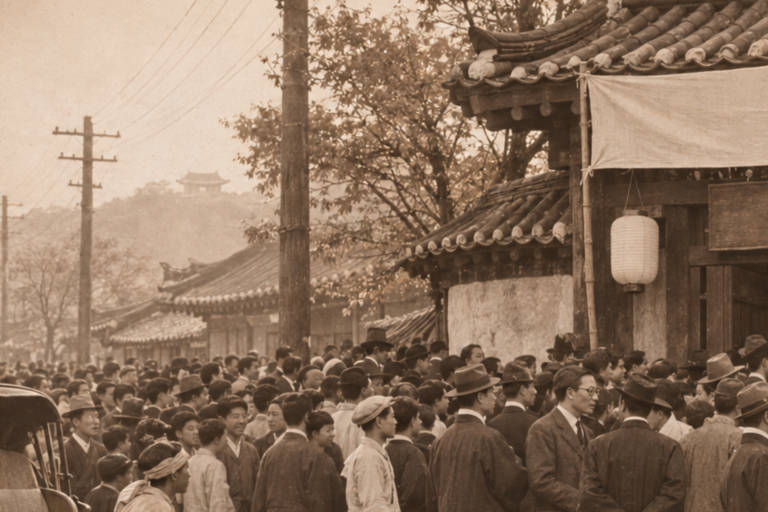
Korea had been under Japanese rule since 1910. The year 1926 was heavy with memory. In April, the last emperor of the Joseon dynasty, Sunjong, died. On June 10, the day of his funeral, crowds in Seoul shouted for independence in what is remembered as the June 10 Movement.
Weather and prices for November 8 are not confirmed in any source we found, so we leave them blank rather than invent them. What we can say is that Gagya Day was a significant cultural moment: a private society, working under colonial censorship, chose a day to honor the Korean script. Gagya Day is the ancestor of today’s Hangul Day, celebrated in South Korea on October 9.
In the north, in November 1926, police uncovered a communications office of the underground Korean Communist Party in Sinuiju, near the Yalu River. Secret documents were reportedly found, and leaders were arrested or went into hiding. Accounts differ on exact dates and names, so we date it only to “November.” Some sources say remaining leaders rebuilt the party leadership in December.

East Asia in Turmoil
In China, the Nationalist Revolutionary Army’s Northern Expedition was reshaping the map. A Peking dispatch dated November 7 reported that the northern forces of the warlord Sun Chuanfang were retreating toward Nanjing. On November 26, the Kuomintang’s Central Political Committee decided to move the capital to Wuhan, and the government relocated there in December. For Koreans in Shanghai, who kept the exiled Provisional Government alive, these shifts mattered directly.
In Japan, 1926 was the last year of the Taisho era. Emperor Taisho would die on December 25, and the era name would change to Showa. On November 8, that change was about six weeks away.

The World Stage
On this same date, on Broadway in New York, George Gershwin’s musical comedy “Oh, Kay!” opened. It is a small reminder that the world of 1926 was not only wars and empires. In the Jazz Age, American theaters were filling with new music at the very moment Korean activists were counting arrests.

Colonial Parallels
Language has often been a front line of colonial politics. Under many empires, the question of which language a people could print, teach, and celebrate was never neutral. In Korea in 1926, a society of linguists could mark a day for the Korean alphabet, but the paper that reported it carried the colonizer’s era name at its head. By comparison, the Irish Free State had been established in 1922, and Irish-language revival there was a state project. Koreans of 1926 had no such state, only societies, schools, and newspapers.
Person of the Day
For this Monday, the person is the anonymous reader. We cannot name a specific individual whose day on November 8, 1926 is documented, and we will not invent one. But a Korean-language newspaper page was the daily window many Koreans had onto each other, and onto a world that was changing fast. Looking ahead, we know that about seven weeks later, on December 28, the independence activist Na Seok-ju, a member of the Uiyeoldan, threw bombs at the Joseon Industrial Bank and the Oriental Development Company in Seoul. Sources say he reached Incheon around December 26. On November 8, that was still in the future.

Understanding Daily Life
We found no confirmed account of ordinary life specifically on this day, so here is only what is solid. Seoul in 1926 was a city of signs in both Korean and Japanese, where tram lines crossed streets lined with traditional tile-roofed houses and new colonial buildings. How individuals spent their Monday is, honestly, not recorded in what we could reach.
Century Mirror
| Topic | 1926 | 2026 |
|---|---|---|
| Day for the Korean script | First “Gagya Day,” Nov 4 | Hangul Day, Oct 9 |
| Masthead date | Japanese era: Taisho 15 | Gregorian calendar |
Today the Korean alphabet is a global cultural export, carried by K-pop lyrics and K-drama subtitles to millions of learners. In 1926 it was a script whose supporters had to fight for a single day of recognition. The line between those two moments runs through people like the members of the Joseon Language Society.

Tomorrow’s Preview
Tomorrow is Tuesday, November 9, 1926. Until then, good night, and join us again at 10:10 PM.
Sources: Dong-A Ilbo, Nov 4, 1926, page 5 (via later commentary); accounts of the Sinuiju incident and Na Seok-ju’s attack; Poverty Bay Herald (PapersPast), Nov 8, 1926; Wikipedia, “November 1926.” No Korean newspaper page dated Nov 8, 1926 was located.

⇓ PNG 다운로드
스마트폰의 WIA Code 스캐너로 이 화면을 약 144초 비추면 기사 전체가 폰에 저장됩니다 — 인터넷 없이 읽을 수 있습니다. WIA Code 스캐너 열기
This code contains the original Korean article.





답글 남기기
댓글을 달기 위해서는 로그인해야합니다.