
Hook Opening – A Quiet Tuesday Between Two Events
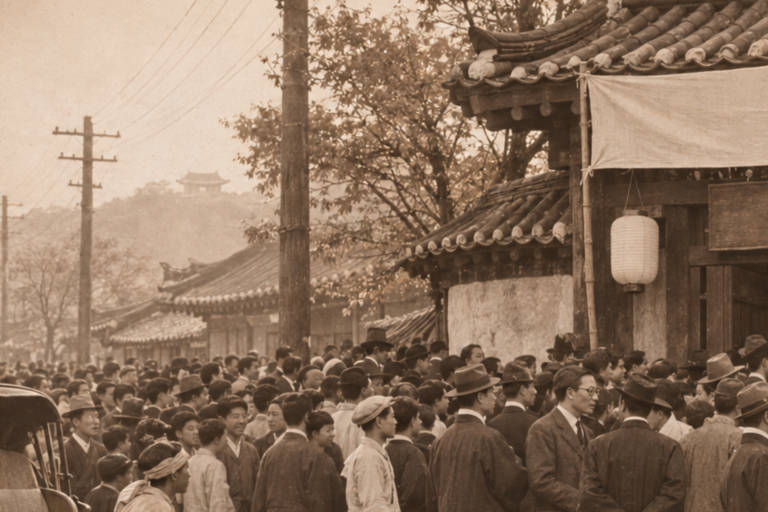
Good evening. It is Tuesday, November 9, 1926, in Gyeongseong, the colonial name for Seoul. As you wind down your day, here is a confession: we could not find the front pages of that day’s Korean newspapers. We found no record of the weather or of the prices. We also found no single headline event for this date in Korea. So we stand on the day itself and look five days back and six days ahead. Between them lies a story about language, newspapers and who is allowed to speak.

Korea Under Colonial Rule – The Day a Script Got a Holiday
Five days earlier, on November 4, 1926 (the 29th day of the ninth lunar month), the Korean Language Society (Joseon-eo Yeonguhoe) and the publisher Sinminsa held a ceremony at the Sikdowon restaurant in Seoul. They marked 480 years since King Sejong promulgated Hunminjeongeum, the original name of the Korean alphabet. They called the day the first “Gagya Day,” after the first two letters of the old alphabet teaching order.
The name did not last. In 1928 it became “Hangeul Day.” From 1934 it was observed on October 28 by the solar calendar. After the 1940 discovery of the Hunminjeongeum Haerye manuscript, the date was reconsidered, and since 1946 it has been October 9. One report adds that the braille system for the blind, Hunmaeng Jeongeum, was announced the same day; that rests on a single outlet, so treat it with care.
Why does a holiday for letters matter under colonial rule? Because language was one of the few shared possessions a colonized people could still gather around in public.

Korea and the Peninsula – A New Paper, and a Long Shadow
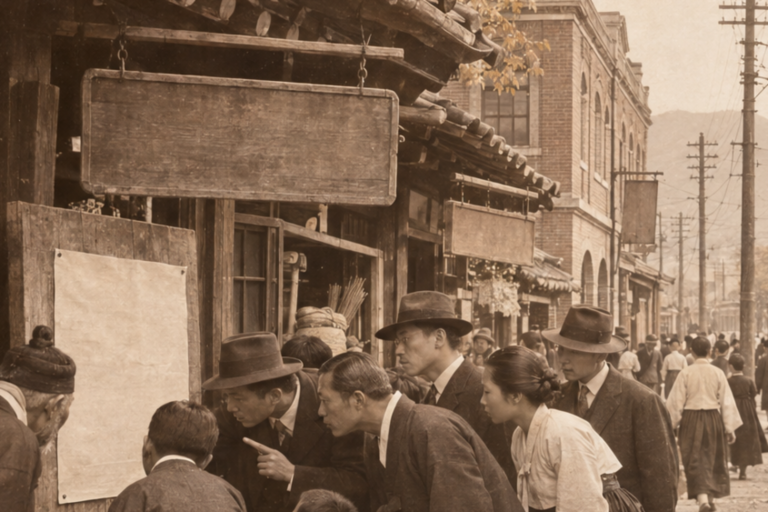
Six days later, on November 15, a new daily called Jungoe Ilbo (the “Home and Abroad Daily”) would launch at 82 Meiji-cho, today’s Myeongdong. According to the Academy of Korean Studies, Yi Sang-hyeop took over the license of the Sidae Ilbo, whose publishing rights had been revoked, and renamed it. Yi served as publisher and editor, and Baek Yeon-gi supplied the funds. A National Institute of Korean History listing puts the Sidae Ilbo’s run at March 31, 1923 to August 31, 1926. The new paper would make a three-way contest with the Dong-A Ilbo and the Chosun Ilbo.
On the legal front, the summer still cast a shadow. After the June 10 independence demonstrations, some 600 students took part, and authorities reportedly meant to detain them all; in the end 11 were tried. One interpretation is that the government wanted to shrink a movement into a mere “incident.” A Korea University catalogue also records that on August 10, 1926, Kang Dal-yeong and 43 others were arrested while some 60 evaded capture. Neither episode happened in November, and we found nothing about the courts on this particular day.

East Asia in Turmoil – Marching Armies in China
In China, Chiang Kai-shek’s National Revolutionary Army was pushing north in the Northern Expedition. Sources disagree on exact dates for the capture of Nanchang and the Wuhan cities, so we will only say that by December the Nationalist government would relocate to Wuhan. Japan, which ruled Korea, was entering the last weeks of the Taisho era: Emperor Taisho would die on December 25, 1926, and the Showa era would begin the same day.
The World Stage – Empty Seats and an Imperial Conference
In Rome, on November 9, the Chamber of Deputies stripped the remaining opposition deputies of their seats. These were the “Aventine” deputies, who had withdrawn from parliament after the murder of Giacomo Matteotti, and Mussolini’s government had removed their immunity by a new law. The Communist deputy Antonio Gramsci was arrested on the night of November 8; sources differ slightly on the exact hour.
In London, the Imperial Conference ran from October 19 to November 23. On November 15 the prime ministers would approve the Balfour Declaration, describing Britain and the Dominions as autonomous communities, equal in status.

Colonial Parallels – Two Meanings of “Equal”
Notice the contrast. In London, empire leaders were writing equality of status into a declaration for the Dominions. In Rome, a parliament was being emptied by law. In Seoul, equality was not on the table at all; a gathering to honor an alphabet was itself a quiet act of identity. Colonial Korea, Fascist Italy and the Dominions were all living under the same word, “empire,” and meeting very different fates.
Understanding Daily Life – Cinema After Dark
We found no account of the theaters on this exact evening. But five weeks earlier, on October 1, Na Un-gyu’s silent film Arirang opened at Dansungsa in Jongno. Records say the line stretched from the first day as far as the YMCA building. An actress later recalled audiences weeping, singing Arirang together and even shouting for independence. Because the film was silent, a live narrator, the byeonsa, told the story. Attendance and box-office figures were not found.

Century Mirror – From Gagya to K-Culture
| Item | 1926 | 2026 |
|---|---|---|
| Alphabet day | First “Gagya Day,” Nov 4 | Hangeul Day, Oct 9 (since 1946) |
| Cinema | Silent Arirang with a live narrator | Arirang is still sung today |
A century ago, creating a single holiday for the alphabet took a room full of people. Today the same alphabet carries K-pop lyrics and drama subtitles around the world.

Tomorrow’s Preview
Tomorrow is Wednesday, November 10, a day to look at schools and young people. In six days, a new newspaper will print its first issue. Good night, and see you at 10:10.
Sources: Encyclopedia of Korean Culture (Jungoe Ilbo); OhmyNews and Bizhankook (Gagya Day); National Archives of Korea (Dansungsa); Korea University Gyeongseong catalogue; Wikipedia, “November 1926” and “1926 Imperial Conference.” Same-day newspaper text, weather and prices were not found.

⇓ PNG 다운로드
스마트폰의 WIA Code 스캐너로 이 화면을 약 151초 비추면 기사 전체가 폰에 저장됩니다 — 인터넷 없이 읽을 수 있습니다. WIA Code 스캐너 열기
This code contains the original Korean article.






답글 남기기
댓글을 달기 위해서는 로그인해야합니다.