
100 Years Ago Today
Wednesday, November 3, 1926 · Evening Edition · 10:10 PM KST (1:10 PM UTC)
10:10 – As the clock smiles, reflect on a century of history
Hook Opening
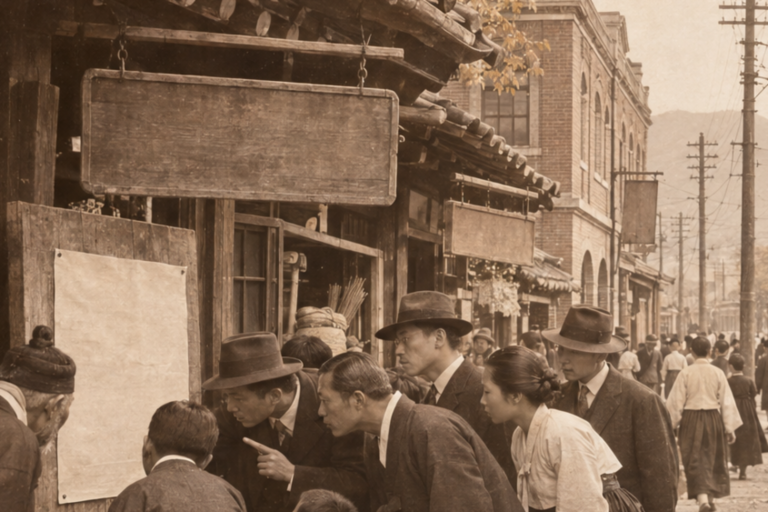
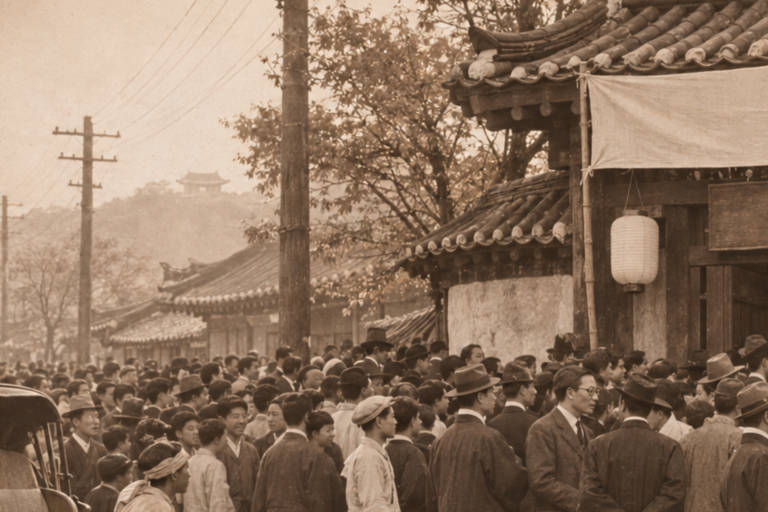
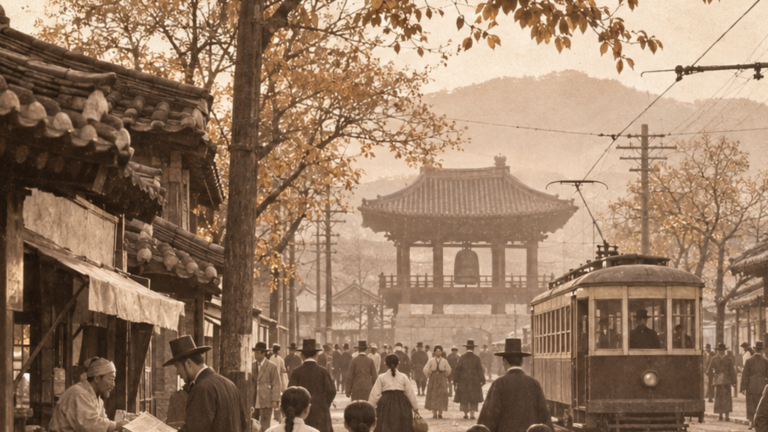
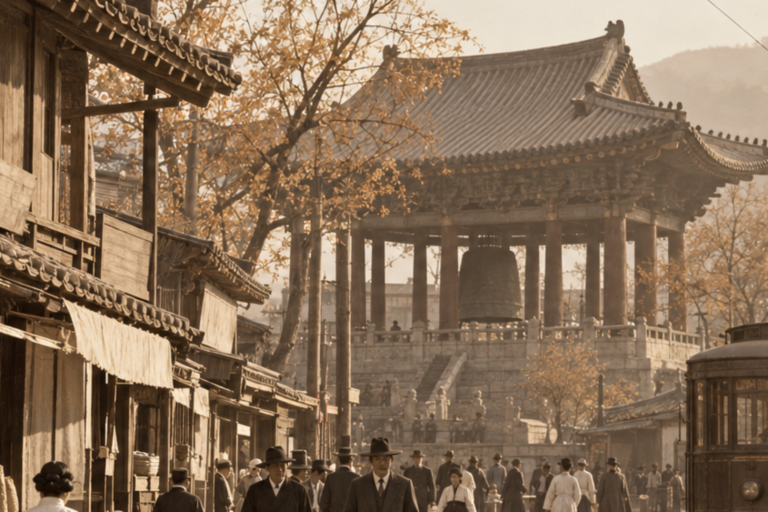
As you wind down your day, picture a Seoul evening a century ago. It is Wednesday, November 3, 1926. Tomorrow, a small group of scholars will gather at a restaurant to celebrate something that colonial rule could not quite erase: a writing system.
A note on sources: we could not locate the full text of this day’s newspapers. So this edition keeps to what is confirmed, and says plainly where records are silent.

Korea Under Colonial Rule
Korea had been under Japanese rule since 1910. On November 4, 1926, the Joseon Language Research Society, whose core members were students of the linguist Ju Si-gyeong, would meet at the Sikdowon restaurant in Gyeongseong (Seoul). The date was the 29th of the ninth lunar month, the 480th anniversary of the promulgation of Hunminjeongeum, the original name of Hangul.
They called it “Gagyanal.” The name comes from “ga gya geo gyeo,” the opening of the syllable chart Koreans recited when first learning to read. It is the name of people who taught children their letters, not of a state ceremony.
That same year, in April, Emperor Sunjong, the last monarch, had died. His funeral in June sparked the June 10th Movement protests. Seoul’s mood in the autumn was shaped by those months. We found no record of what preparations for the event looked like, or how the streets felt on this particular morning, so we do not invent them.

East Asia in Turmoil
In Japan, November 3 was the birthday of the late Emperor Meiji. It became an official national holiday, Meiji Setsu, only in 1927 at the request of the Imperial Diet. Emperor Taisho, already in failing health with Hirohito acting as regent since 1921, would die on December 25 of this very year, ending an era.
Korea’s private newspaper market was also changing. Reports say that in November 1926 the Jungoe Ilbo launched, joining the Chosun Ilbo and Dong-A Ilbo to make a three-way contest. We could not confirm the exact launch date.

The World Stage
Elsewhere on November 3, 1926, chronologies record that the American sharpshooter Annie Oakley, star of Buffalo Bill’s Wild West Show, died at age 66 in Greenville, Ohio. Ty Cobb is recorded as stepping down as manager of the Detroit Tigers. In Poland, Marshal Józef Piłsudski reportedly issued a decree restricting the press, banning news that might provoke public demonstrations and material mocking or criticizing officials and judges.
These items come from summary sources rather than period newspapers, and we flag them as such.

Colonial Parallels
A language is often the first thing an empire tries to shrink, and the first thing a people hold onto. Korea in 1926 is one example of a broader pattern across the colonial world of the 1920s, where schools, newspapers and printing were contested ground. The Polish decree of the same day is not colonial, but it shows how widely governments of the era treated the press as something to manage.
Person of the Day
Park Doo-seong, a Korean educator of blind students, announced Hunmaengjeongeum, a Hangul-based Braille system, on November 4, 1926, the same day as Gagyanal. His work was meant to let blind Koreans read their own language. November 4 is now Korea’s Hangul Braille Day.
Understanding Daily Life
Wednesdays in this series look at schools, youth and food. For November 3, 1926, we found no confirmed account of school scenes or market prices in Seoul, so we leave the page honest rather than full. Historians know days like this exist in the record only as gaps. Naming the gap is part of the work.

Century Mirror
| Item | 1926 | 2026 |
|---|---|---|
| Hangul commemoration | Gagyanal, Nov 4 (29th day, 9th lunar month) | Hangul Day, October 9, a national observance |
| Name | Renamed “Hangul Nal” from 1928 | Hangul Day |
| Why the date moved | Counted by the lunar calendar | Set to Oct 9 after the Hunminjeongeum Haerye manuscript was found in 1940 |
| Braille | Hunmaengjeongeum announced Nov 4 | Hangul Braille Day, Nov 4 |
Today Hangul reaches the world through K-pop lyrics and K-drama subtitles. A century ago it was celebrated by a few dozen people in a restaurant room.

Tomorrow’s Preview
Tomorrow is November 4, 1926: Gagyanal. Join us again tomorrow evening at 10:10, as the clock smiles.
Sources: multiple reports on the origin of Hangul Day and Gagyanal; chronology and summary sources for November 3, 1926 world items. Full-text newspapers for the day were not located.

⇓ PNG 다운로드
스마트폰의 WIA Code 스캐너로 이 화면을 약 162초 비추면 기사 전체가 폰에 저장됩니다 — 인터넷 없이 읽을 수 있습니다. WIA Code 스캐너 열기
This code contains the original Korean article.




답글 남기기
댓글을 달기 위해서는 로그인해야합니다.