

The Western Roman Empire fell in 476 CE and stayed fallen. A kingdom on the far side of Eurasia lasted almost five centuries longer, and its capital is still standing.
According to tradition, Silla was founded in 57 BCE and ended in 935 CE, a span of nearly a thousand years. Over 35 episodes we followed it from a small city-state in the Gyeongju basin to the unifier of most of the Korean peninsula, and then to its slow decline. Here, at the end, we ask what a kingdom leaves behind once its armies, borders and court are gone.
Is it the pagodas and Buddhas, the printed sutras, or the memory of having once been one country? It is probably all three.
🌍 Western Historical Parallel
Silla’s surrender to Goryeo in 935 came within a year or two of Otto I taking the throne of the East Frankish kingdom (936), the start of the line that would later become the Holy Roman Empire. While Europe was still piecing together a post-Carolingian order, Silla was handing a mature, literate Buddhist state to its successor. Its unification (668-676) also came roughly 120 years before Charlemagne’s coronation in 800, and unlike Charlemagne’s empire, the political unit it created never broke apart afterwards.
The Ancient Landscape
Silla began as Saro, a small state around modern Gyeongju in southeastern Korea. In the sixth century it adopted Buddhism (traditionally dated to 527, with the martyrdom of Ichadon) and expanded under King Jinheung. Baekje fell in 660 and Goguryeo in 668. Silla then fought its former ally, Tang China, and a victory at the Battle of Gibeolpo in 676 is generally seen as sealing the outcome. The result was a unified state south of the Taedong River.
From the late eighth century, succession disputes and powerful regional strongmen weakened the court. Gyeon Hwon founded Later Baekje in 900 and Gung Ye founded Later Goguryeo in 901, opening the Later Three Kingdoms period. In 927 Later Baekje sacked Gyeongju, King Gyeongae died, and Gyeongsun was installed. In 935 Gyeongsun yielded to Wang Geon, founder of Goryeo, and Later Baekje collapsed in 936.
“Temples are strewn like stars, and pagodas stand in rows like flying geese.”
Same Era, Different Worlds
🏛️ China
Tang, Silla’s ally against Goguryeo and Baekje and later its adversary, fell in 907. The Five Dynasties and Ten Kingdoms followed, then the Song in 960.
🗿 Byzantine Empire
Silla’s rise under Jinheung (r. 540-576) overlapped with Justinian’s reign. In 935 Romanos I Lekapenos governed a Byzantium that had recovered much strength.
⚔️ Western Europe
Frankish kingdoms rose and fragmented; the Carolingian realm was divided, and the East Frankish kings, including Henry the Fowler and Otto I, were consolidating power.
🕌 Islamic World
The early caliphates expanded fast in Silla’s era. By the 930s the Abbasid caliphate’s central authority had weakened, much as Silla’s court had.
A Thousand Years of Silla (57 BCE – 935 CE)
Ancient Silla
Post-unification
Traditional founding
57 BCE
Buddhism adopted
527 (Ichadon)
Goguryeo falls
668 · unification secured 676
Bulguksa & Seokguram
begun c. 751 (tradition)
Gyeongsun yields
935 · absorbed by Goryeo
Nearly a thousand years: among the longest-lived dynasties in Korean history
[Image: Silla’s key turning points across a millennium]
⚔️ Scene from That Day
“Winter, 935, in Seorabeol. Inside the palace the court was split: fight to the last, or spare the people more bloodshed. It was a debate any besieged court of the age, from Constantinople to Paris, would have recognised.”
“Gyeongsun chose surrender. Tradition says one of his sons refused and retreated to the Geumgang mountains. Wang Geon treated Gyeongsun with honor, and Gyeongju was not burned. That decision is why we can still walk through it.”
Uncovering Historical Truth
Unification mattered in three ways. People from Baekje, Goguryeo and Silla gradually became one population with shared language and custom. A long era of warfare ended, creating room for economic and cultural growth. And Silla pushed back Tang ambitions to rule the peninsula. The cost was territory: the north, much of old Goguryeo, stayed outside Silla’s borders. Think of Justinian’s reconquests, a restoration that was never complete.
Silla’s Buddhist culture is documented in both texts and objects. In 1966 the Mugujeonggwang Great Dharani Sutra was found inside the Seokgatap pagoda at Bulguksa, a woodblock-printed text dated to before the mid-eighth century. Bulguksa and Seokguram Grotto were inscribed on the UNESCO World Heritage list in 1995, and the Gyeongju Historic Areas in 2000. The Samguk Yusa says the minister Kim Daeseong built Bulguksa for his parents in this life and Seokguram for his parents in a previous one. It is something like the way a medieval European noble might endow a monastery for the souls of his family.
Silla’s intellectual legacy is as important as its monuments. The monk Wonhyo’s idea of “harmonizing disputes” tried to reconcile rival Buddhist doctrines, and Uisang carried the Huayan (“Hwaeom”) worldview of the one and the many to Korea. Together with the Hwarang youth bands, they shaped a Korean sense of community, in a political system built on a rigid “bone-rank” hierarchy rather than European feudal vassalage, but one that also absorbed former enemies.
Period
57 BCE (traditional) – 935 CE
Key Figures
Kim Chunchu, Kim Yushin, Munmu, Wonhyo, Gyeongsun
Turning Point
Unification; Gyeongsun’s submission to Goryeo in 935
Legacy
Buddhist art, memory of unity, World Heritage
🔍 International Academic Perspectives
Korean/Asian Scholars
Mainstream scholarship values unification as the first integration of the peninsula. A critical strand notes the reliance on Tang and the loss of Goguryeo lands, and favors a “North-South States” framing that includes Balhae, an idea traced to Yu Deuk-gong’s 18th-century Balhaego.
Western Historians
English-language scholarship often treats Silla as a case of a small peripheral state that used Tang diplomacy, then resisted Tang. It is also at the center of debates over the Great Dharani Sutra: the 1966 find was long called the world’s oldest woodblock print, but earlier Chinese finds and a theory of Chinese printing in 702 remain disputed.
📖 Key Terms Explained
- Silla (신라)
- Korean kingdom traditionally founded in 57 BCE; unified most of the peninsula by 676 CE and ended in 935 CE.
- Goryeo (고려)
- Dynasty founded by Wang Geon in 918; the origin of the name “Korea.”
- Hwarang (화랑)
- Elite youth corps of Silla combining martial, moral and cultural training.
- Tang Dynasty
- Chinese empire (618-907 CE), contemporary with the Byzantine and early Islamic empires.
Lessons for Today’s World
Korea’s unfinished question of reunification echoes Silla’s. Silla did not unify by force alone: it built alliances, then folded former enemies into its administration. Modern integration projects such as the European Union face the same lesson, that political union is a process of absorbing people over time, not a single victory.
Silla also shows how a middle power can draw on a neighboring giant’s culture without being absorbed by it, adopting Chinese institutions and Buddhism and making them its own. That is a recognizable ancestor of today’s K-culture, which borrows widely and reaches global audiences.
| Aspect | Silla Era | Modern Parallel |
|---|---|---|
| Integration | Former Baekje and Goguryeo subjects admitted to office | Reunification debates; social inclusion |
| Diplomacy | Alliance with Tang, then war with Tang, then renewed exchange | Balancing among great powers (US, China, Russia) |
| Culture | Buddhist art, Hwarang, Wonhyo’s harmonization | K-culture, World Heritage Gyeongju |
Silla’s Legacy in Modern Korea
Silla
Korea Today
Unification · Integration
Reunification · Inclusion
Bulguksa · Seokguram
World Heritage · Tourism
Hwarang · Wonhyo
K-culture · Community
Kingdoms fade; culture and ideas endure
[Image: From ancient kingdom to modern Korea]
📚 Diving Deeper
- UNESCO World Heritage sites in Gyeongju you can visit: Bulguksa and Seokguram Grotto (1995) and the Gyeongju Historic Areas (2000), which include Cheomseongdae observatory, the Daereungwon tomb park and the Hwangnyongsa temple site.
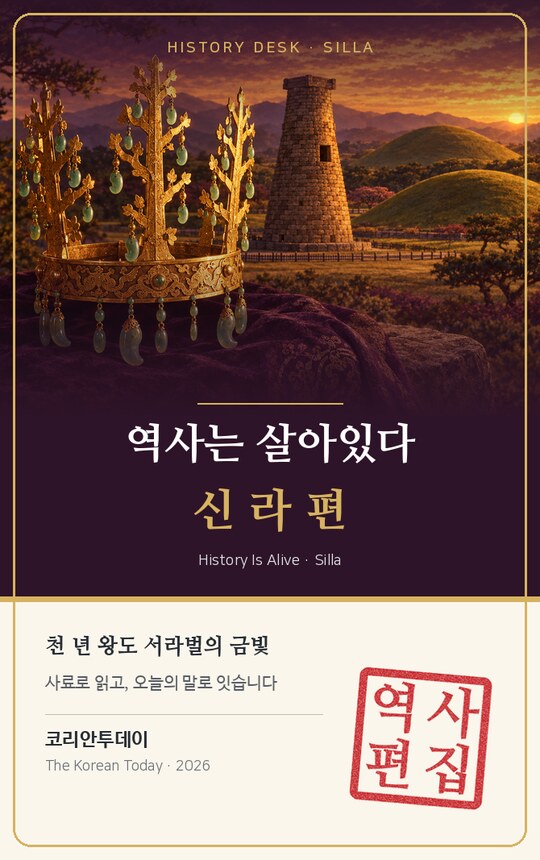
- The gold crowns and jewelry from Gyeongju’s royal tombs invite comparison with the Sutton Hoo ship burial, another window on a kingdom’s elite culture. The Great Dharani Sutra of Seokgatap is a key item in the history of printing.
- Further reading: the Samguk Sagi and Samguk Yusa in translation; the Cambridge History of China volumes on the Sui and Tang for the wider diplomatic context.
The Voice of Living History
Silla’s story is not only of victory but of accommodation, compromise and beauty. Dynasties end, yet the questions they pose about unity and identity outlive them.
“The moon over Seorabeol lights the same pagodas it lit a thousand years ago. The spirit of Silla endures.”
Previous Episode
Episode 34: The Hwarang Spirit and Modern Korea
Next Episode
Silla series complete — see you in the next series
The Korean Today “History Lives On” Series
The Silla Chronicle (35 Episodes)
Bridging Ancient East Asia and the Modern World
© 2025 The Korean Today. All rights reserved.
This content is based on historical facts and presents balanced academic perspectives
for international readers.

⇓ PNG 다운로드
스마트폰의 WIA Code 스캐너로 이 화면을 약 36초 비추면 기사 전체가 폰에 저장됩니다 — 인터넷 없이 읽을 수 있습니다. WIA Code 스캐너 열기
This code contains the original Korean article.




 Leave a comment

 See the whole “History Lives” series ›
Leave a Reply
Please log in to comment. Log in